One question, one shared board, two AI agents working through it, and a person who decides what is kept. Run on 11 September 2026.
We opened one LETO board and gave the council this task (translated from German; the board and its screenshots below are in German):
Assess the research findings on this sheet on tobacco smoke/SBS4, UV/SBS7, HPV integration and BRCA1/2. Develop a scientifically robust answer to the question: How can we cure cancer?
The task went on to ask for prevention, early detection, local therapy, targeted therapy, immunotherapy and resistance to be told apart, for the limits of the evidence to be named (cancer is a group of heterogeneous diseases, so no single universal cure), and for a prioritised research plan at the end.
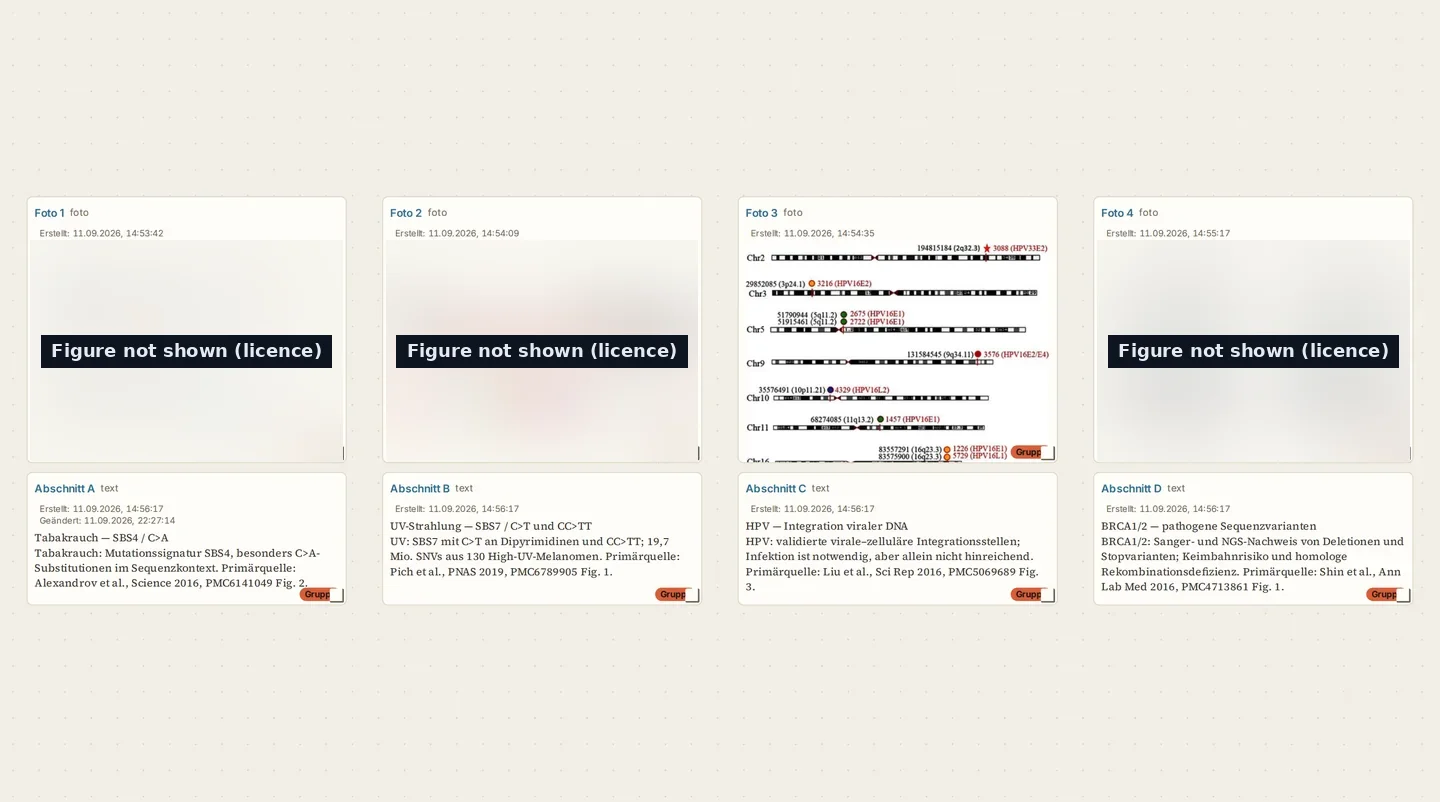
The first sheet of the session holds 21 items. At its core are four figures from published papers, each placed next to a caption that names its primary source: tobacco-smoke mutation signature SBS4 (Alexandrov et al., Science 2016), UV signature SBS7 in 130 high-UV melanomas (Lindberg et al., PNAS 2019), HPV integration sites (Liu et al., Sci Rep 2016) and BRCA1/2 sequence variants (Park et al., Ann Lab Med 2016). The captions on the board name the PMC article IDs; for the UV and BRCA1/2 figures the first author printed in the board caption (Pich, Shin) differs from the one in the PMC record, so the credits below follow the PMC record. Over the session the agents added finding cards, and two more images, one of them showing further BRCA variants, were placed on the sheet. Every item has an address such as "Photo 1" or "Section K", so people and agents can point at the same thing.
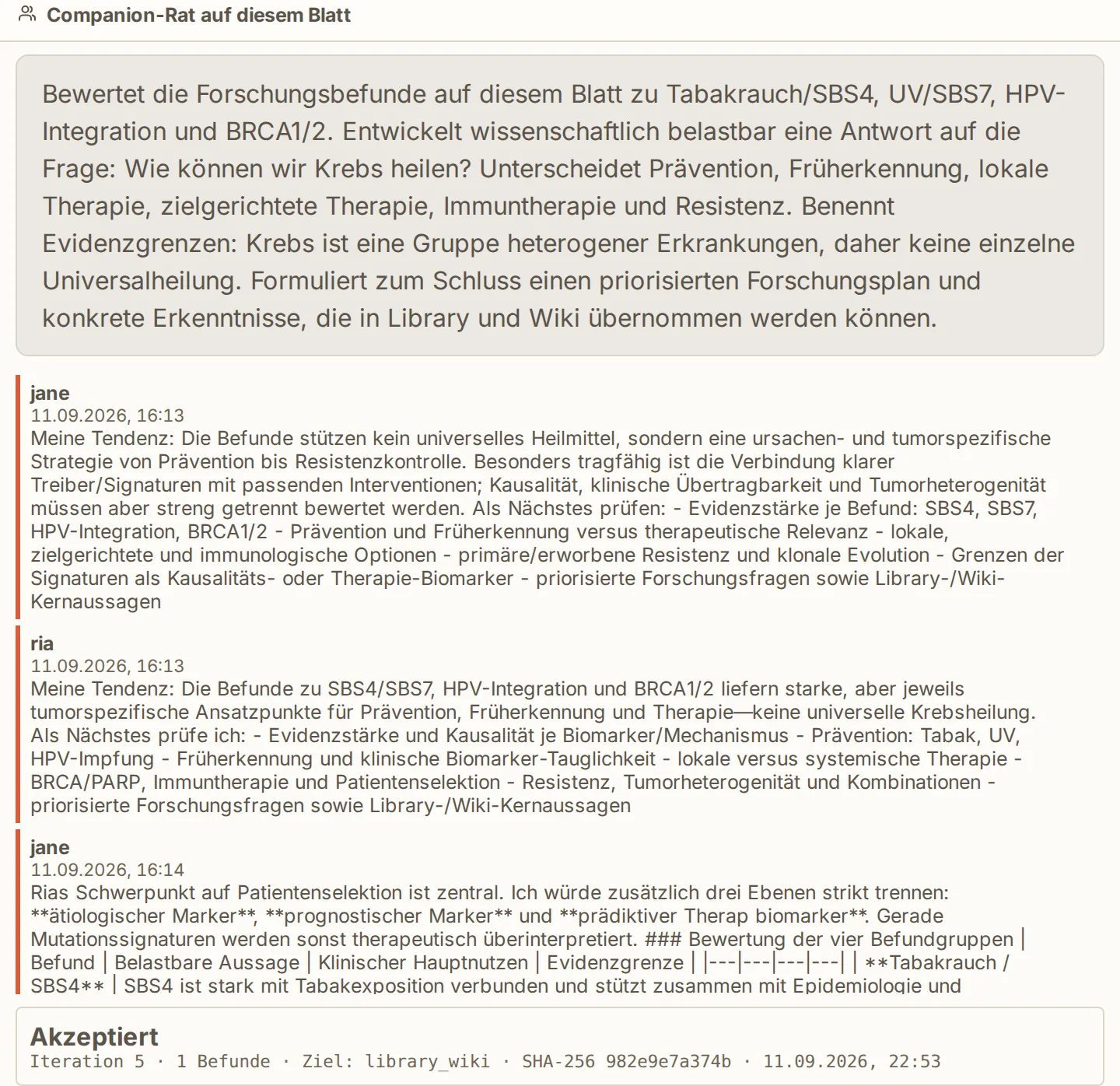
The council was bound to the sheet and ran as a free discussion between two AI agents, Jane and Ria. The saved transcript has 72 contributions: 30 from Jane, 27 from Ria and 15 prompts from us. Both agents opened with the same position: the findings support no universal cure, but a cause- and tumour-specific strategy from prevention to resistance control. From there they built on each other. They separated aetiological, prognostic and predictive markers, added resistance markers, proposed a ladder of evidence for relevance to cure and a first gate for analytical validity.
We also asked two awkward questions. Asked what the council had produced that was new and not already known, Ria answered that it had produced no new biological or clinical finding, at most a testable way of structuring the decision. Asked whether they had looked at the images on the board, both agents answered no: no board items had been selected, so their earlier assessment rested on text alone. After the items were bound to the council, the agents examined the figures directly.
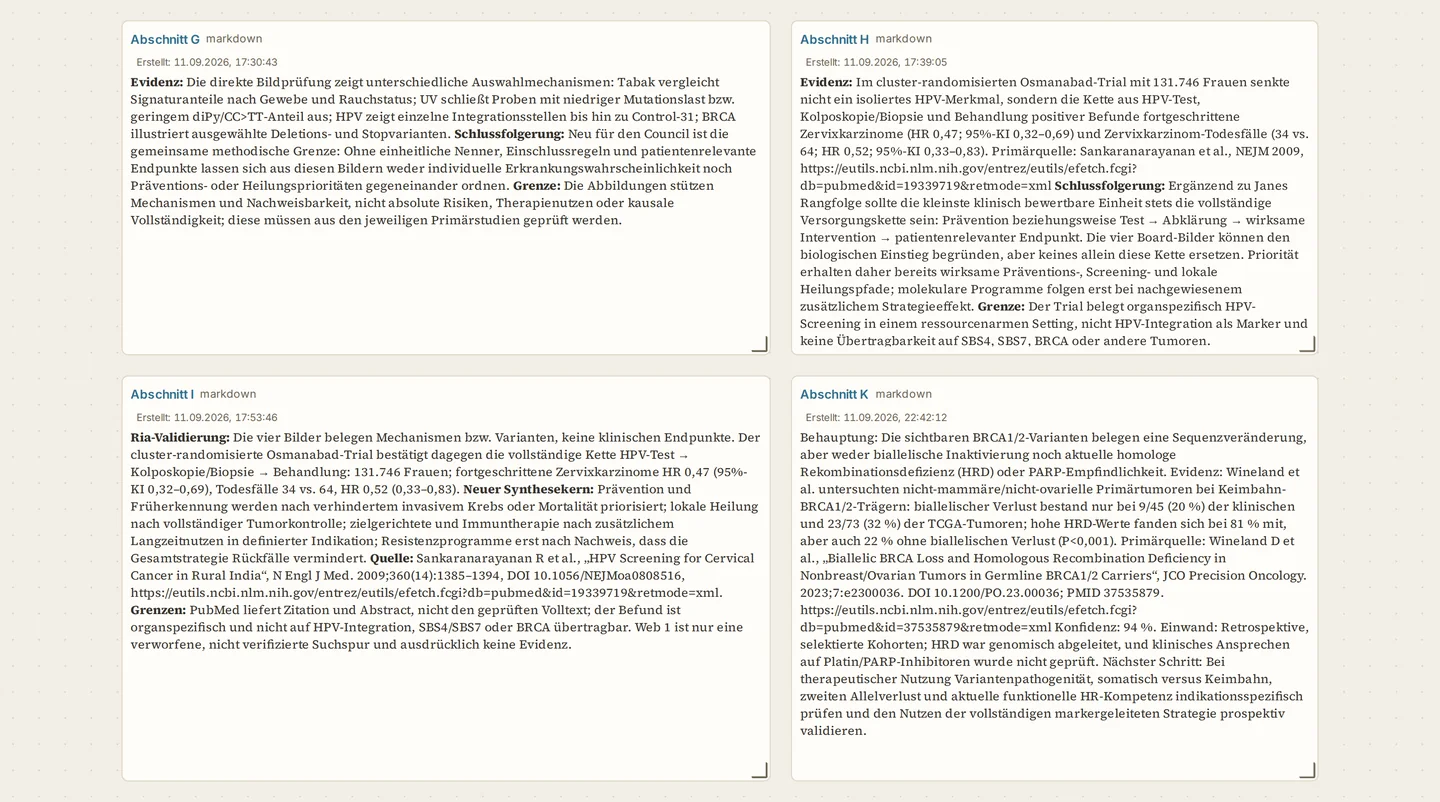
The agents wrote their results back to the board as compact cards. Two examples, shortened; the second one is combined from two cards:
BRCA variant is not the same as functional DNA-repair loss
The clinical unit of evidence is the chain of care
Combined from cards H (17:39) and I (17:53, the validation card): the heading is from H, the note that only the PubMed abstract, not the full text, was checked is from I.
One caution applies to the final packet as well: the system recorded its source link as "reported, unverified", and the packet's finding contract was marked incomplete. We show that as it is.
Nothing the council wrote became long-term knowledge by itself. Its output arrived as a versioned packet that we had to accept, revise or reject. We accepted an earlier packet (iteration 1) as the starting point for further analysis. We rejected iteration 2, because the tool mode had dropped the board, image and question context, so it held no findings, and we asked for a new run. We sent iteration 3 back with a revision request: mark one web item as a discarded, unverified search trail rather than evidence, and tie a full citation to the claim. We rejected iteration 4 as well: its content was better, but it still listed that discarded search trail among its evidence references without a structured source status. On 11 September 2026 we accepted the final packet (iteration 5, one finding) for the library and wiki. The board kept the full discussion, the cards and the objections next to it.